
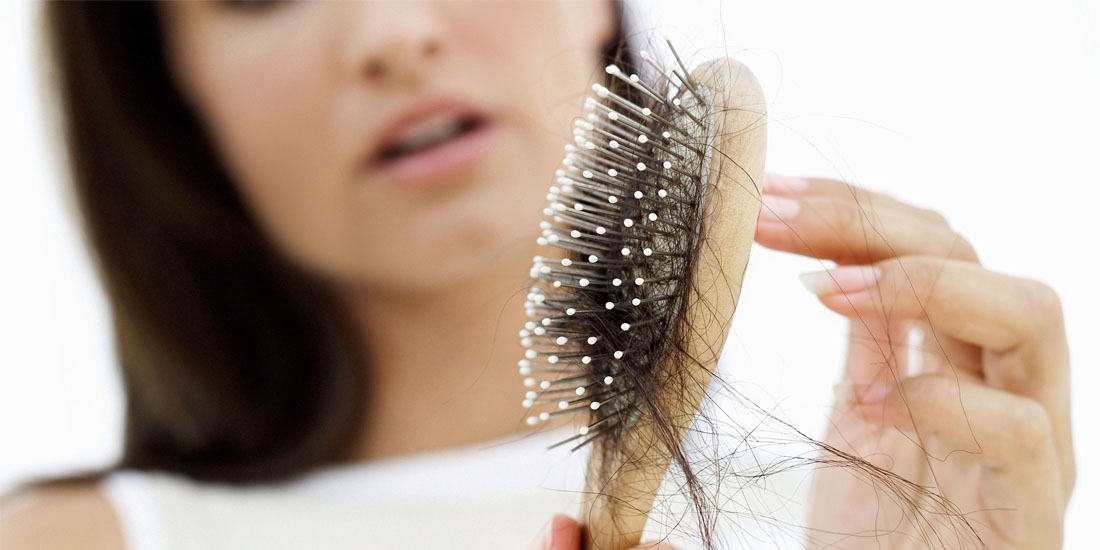
FEMALE PATTERN HAIR LOSS: Female pattern hair loss (FPHL) is defined as a progressive, non-scarring miniaturization of the hair follicle, usually with a characteristic pattern distribution that occurs in genetically predisposed women. Female pattern hair loss (FPHL) is a common diagnosis in medical practice.
Less commonly, women with FPHL may have other cutaneous or systemic signs of hyperandrogenism such as hirsutism, acne, irregular menstruation, infertility, galactorrhea, and insulin resistance. The most common endocrinological abnormality associated with FPHL is polycystic ovary syndrome (PCOS).
The most important diseases to consider in the differential diagnosis of FPHL include chronic telogen effuvium (CTE), permanent alopecia areata post chemotherapy (PAC), alopecia areata incognito (AAI), and frontal fibrosing alopecia (FFA). ). Female pattern hair loss is a common condition. Incidences are reported to be 12% in women around the age of 30 and 30–40% in the female population between the ages of 60 and 69. The condition usually presents after puberty with variable clinical severity and rate of progression, but can occur at any age. The earlier it presents, the more intense the clinical picture tends to be. When androgen levels are elevated, the role of these hormones is fairly clear, although it should be noted that hyperandrogenism per se does not necessarily cause FPHL. The mechanism by which androgens cause hair loss has been linked to increased production of cytokines, which induce hair to enter the telogen phase and the dermal papilla to become senescent.
The genetic inheritance of FPHL is still unclear. FPHL may be a multigenic disease, but the causative genes are not established. Polymorphism in one of the two major susceptibility genes for male pattern baldness, the androgen receptor gene EBA2R on the X chromosome, has recently been associated with early onset of FPHL. The role of the aromatase genes CYP19A1 has been reported but not confirmed in a more recent study. In other studies, there was no association between steroid 5-alpha-reductase isoform genes or sex steroid hormone receptors and FPHL. There was also no association with the melanocortin 4 receptor gene.
FPHL is often precipitated and exacerbated by conditions that cause telogen effuvium, such as medications, acute stressors, weight loss, childbirth, and hormonal therapies with proandrogenic effects such as norethisterone, levonorgestrel, and tibolone. Female pattern hair loss is also called female androgenetic alopecia because of its possible association with impaired androgen metabolism and familial occurrence.
TREATMENT
- Minoxidil 2% Solution: It should be used for at least 12 months. It increases hair loss at the first use.
- Antiandrogens: Synthetic antiandrogens are used orally to block binding to androgen receptors. They include cyproterone acetate, spironolactone, and flutamide.
- Finasteride: Finasteride is a 5 alpha-reductase type 2 inhibitor that inhibits the conversion of testosterone to dihydrotestosterone (DHT).
- Dutasteride: Dutasteride is a 5 alpha-reductase type one and two inhibitor. It inhibits the conversion of testosterone to dihydrotestosterone.
- Estrogens: Estrogens have an uncertain role in human hair growth. The hair follicle has different estrogen receptors: alpha and beta. The beta receptor is the most common one present in the scalp and generally suppresses cellular function in the hair follicle. In vitro studies are inconclusive and show that estrogens may have opposite effects on male scalp hair, where they induce stimulation, compared to female scalp hair, where they inhibit hair elongation.
- Lasers and light treatments: Lasers and light treatments are monochromatic lights that use wavelengths between 600 and 1400 nm, in the red/infrared spectrum. There is some evidence that light treatments can stimulate hair growth and the mechanism by which this occurs is uncertain. The effects of light treatment may be attributed to the absorption of red/infrared light by the skin which is then absorbed by the cellular respiratory chain. The Lasercomb Hair MaxR is a handheld laser device that uses a wavelength of 655 nm that is widely marketed to patients as a hair regrowth device. There is one controlled study in men showing the effectiveness of this technology, but there are no published studies in women.
- Prostaglandin analogues: Latanoprost and bimatoprost were originally developed for ocular glaucoma and a side effect observed was eyelash growth. There is a study in men showing that latanoprost 0.1% increased scalp hair density compared to baseline and placebo, but the study only included 16 male patients and the drug was applied to a very small area of the scalp. Different classes of prostaglandins appear to have opposing actions in the hair follicle.
- Hair transplantation: When hair loss has stabilized in patients over 25 years of age, hair transplantation is an alternative. The gold standard technique is follicular unit transplantation (FU), due to a better result in terms of natural architecture and final appearance. Hair follicles are implanted individually following the patient’s natural hairline. This is a multi-stage procedure that must be performed by an experienced surgical team. The results will depend on the sufficient donor area, the number of hairs transplanted, the quality of the hair harvested, and the recipient area. The most common problems encountered during hair transplantation in women are related to the insufficient donor areas of hair and the need to insert the grafts between the existing hair follicles present in the recipient area.